Table of Contents
ToggleIntroduction
Choosing the right ecommerce website builder in 2026 is one of the most consequential decisions you will make for your online business. The platform you pick determines your storefront’s speed, your customers’ checkout experience, the fees you pay on every sale, and how easily you can scale from ten orders a month to ten thousand.
The best ecommerce website builders in 2026 are focused on helping businesses create faster, mobile-friendly, and conversion-optimized online stores. Choosing the best website builder for online store management allows brands to improve customer experience and streamline daily operations. Many entrepreneurs prefer the best ecommerce website builder for small business growth because these platforms offer affordable pricing and scalable ecommerce features.
When comparing the best ecommerce website builders in 2026, businesses should focus on scalability, SEO tools, payment gateway support, and mobile shopping performance. The best website builder for online store growth should also provide fast loading speed, secure checkout, and flexible customization options. Choosing the best platform to build ecommerce website infrastructure helps improve customer experience, search engine visibility, and long-term online sales performance.
Why Choosing the Best Ecommerce Website Builders Matters for Your Online Store in 2026
Choosing the best ecommerce website builders is important for businesses that want to improve online visibility and increase sales in 2026. The best ecommerce website builder for small business owners should provide SEO-friendly features, secure payment options, and mobile-responsive templates. A reliable best website builder for online store growth also helps businesses manage products, customers, and marketing campaigns more efficiently.
Choosing the best ecommerce website builders is important for businesses that want to improve online visibility and increase sales in 2026. The best ecommerce website builder for small business owners should provide SEO-friendly features, secure payment options, and mobile-responsive templates. A reliable best website builder for online store growth also helps businesses manage products, customers, and marketing campaigns more efficiently.
In 2026, the stakes are higher because the competitive environment has changed. Mobile commerce now accounts for over 72% of all ecommerce transactions. AI-powered product recommendations, personalization engines, and conversational shopping experiences are moving from enterprise to mid-market. Platforms that cannot support these capabilities are already becoming a ceiling for ambitious merchants.
Choosing the right ecommerce website builder is not about picking the most popular name. It is about matching a platform’s strengths to your specific business model, audience, and growth trajectory.
How to Choose the Best Website Builder for Online Store Success
Before reviewing specific platforms, it helps to have a clear evaluation framework. The following criteria should guide your comparison:
- Pricing and Transaction Fees: Understand the full monthly cost, including app subscriptions, premium themes, and per-transaction fees if you use a third-party payment gateway.
- Ease of Use: How quickly can a non-technical founder build, customize, and update their store without developer help?
- Design Flexibility: Does the platform offer professional, conversion-optimized themes that can be customized without code?
- SEO Capabilities: Look for editable meta titles, clean URL structures, structured data support, automatic sitemaps, and fast Core Web Vitals.
- App and Integration Ecosystem: Can you connect the tools you already use — email marketing, inventory management, shipping, analytics?
- Payment Gateway Compatibility: Which gateways are supported natively, and what are the fees for using third-party processors?
- Scalability: Can the platform handle 10x your current traffic and catalog size without requiring a full migration?
- Support Quality: Is 24/7 support available? Is it chat-based, email, or phone?
The best platform to build ecommerce website stores should support fast loading speed, customizable themes, and advanced ecommerce integrations. Many businesses choose Shopify and WooCommerce because they are considered among the best ecommerce website builders for scalability and performance. Selecting the best online store builder can help improve customer experience, search rankings, and long-term business growth.
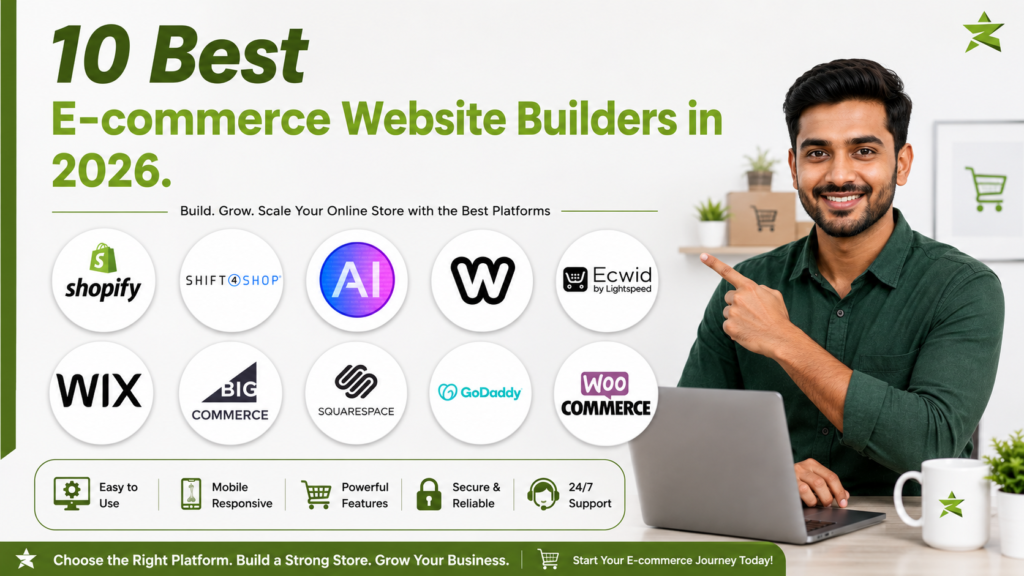
10 Best Ecommerce Website Builders for Small Business Owners in 2026
1. Shopify — Best Overall Ecommerce Platform
Shopify remains the gold standard for ecommerce in 2026. It powers over 4.6 million live stores globally and has consistently invested in the infrastructure, tooling, and merchant ecosystem that makes it the most complete solution available.
The platform’s Basic plan starts at $39/month, with Shopify ($105/month) and Advanced ($399/month) tiers offering reduced transaction fees, more staff accounts, and advanced reporting. Shopify Payments eliminates third-party transaction fees entirely, which is the single biggest cost lever for most merchants.
The app store offers over 8,000 integrations covering everything from subscription billing to B2B wholesale. Shopify’s native checkout conversion rates are among the best in the industry, and the platform’s Liquid templating system gives developers significant customization control without touching the core infrastructure.
- Best for: Most merchants — from first-time sellers to established brands
- Standout feature: Shop Pay checkout (highest-converting checkout in ecommerce)
- Limitation: Monthly costs escalate quickly with apps; transaction fees on third-party gateways
- Pricing: From $39/month
2. WooCommerce — Best for WordPress Users and Full Ownership
WooCommerce is a free, open-source plugin that turns any WordPress site into a fully functional online store. It powers approximately 36% of all ecommerce stores on the internet — a market share no hosted platform comes close to matching.
The core plugin is free, but the real costs come from hosting ($10–50/month), premium extensions, and developer time for customization. The key advantage over hosted platforms is complete data ownership. There are no transaction fees beyond standard payment gateway rates, and no artificial limits on products, bandwidth, or staff accounts.
WooCommerce is the strongest choice for merchants who already run a WordPress site, who have developer resources, or who want maximum flexibility and no long-term platform dependency. It requires more setup effort than hosted solutions but delivers unmatched customization in return.
- Best for: WordPress users, developers, merchants wanting full ownership
- Standout feature: Zero platform transaction fees; unlimited extensibility
- Limitation: Requires hosting setup, maintenance, and security responsibility
- Pricing: Free plugin; hosting from ~$10/month
3. BigCommerce — Best for Mid-Market and Growing Brands
BigCommerce targets merchants who have outgrown Shopify’s Basic and mid-tier plans but are not ready for enterprise platforms like Salesforce Commerce Cloud. Its standout differentiation is no per-transaction fees on any plan, even when using third-party payment gateways — a significant saving for high-volume merchants.
The platform includes robust native B2B features, multi-storefront management, and advanced SEO controls out of the box. Its open SaaS architecture allows custom frontends via headless commerce, making it a popular choice for brands that want developer flexibility without managing hosting infrastructure.
- Best for: Mid-market brands, B2B merchants, fast-growing DTC businesses
- Standout feature: No transaction fees on any plan
- Limitation: Annual sales caps on lower plans; fewer apps than Shopify
- Pricing: From $39/month (Standard)
4. Wix eCommerce — Best for Beginners and Small Stores
Wix has evolved well beyond its drag-and-drop website builder roots. Its ecommerce functionality now supports dropshipping, digital products, subscriptions, and multi-channel selling through a genuinely beginner-friendly interface.
The platform shines for merchants who prioritize ease of use and design control above all else. Its ADI (Artificial Design Intelligence) tool can generate a complete store layout from a brief description in minutes. However, Wix charges transaction fees on lower plans, and its performance at scale — large catalogs, high traffic — lags behind Shopify and BigCommerce.
- Best for: Beginners, lifestyle brands, stores with under 500 products
- Standout feature: Drag-and-drop design with genuine visual freedom
- Limitation: Performance limitations with large catalogs; transaction fees on base plans
- Pricing: Ecommerce plans from $27/month
5. Squarespace Commerce — Best for Design-Led Brands
Squarespace has long been the preferred choice of photographers, designers, and lifestyle brands who want their storefront to look as polished as the products they sell. Its Commerce plans are fully integrated — no separate ecommerce plugin required — and the templates are consistently the best-looking in the industry.
The platform supports physical products, digital downloads, services, and subscriptions. It lacks the app ecosystem depth of Shopify but compensates with tightly integrated native tools for SEO, email marketing, and analytics.
- Best for: Creative professionals, fashion brands, food and beverage, luxury goods
- Standout feature: Best-in-class visual design templates
- Limitation: Limited payment gateway options; smaller app ecosystem
- Pricing: Commerce Basic from $36/month
6. Ecwid by Lightspeed — Best for Adding a Store to an Existing Site
Ecwid is the most practical solution for businesses that already have a website and want to add ecommerce functionality without rebuilding from scratch. It integrates with WordPress, Wix, Weebly, and any website that accepts custom HTML. Its free plan supports up to five products, making it a genuine no-cost starting point.
Lightspeed’s acquisition of Ecwid brought stronger POS integration, making it particularly attractive for brick-and-mortar retailers expanding online. The platform handles multi-channel selling natively and syncs inventory across Instagram, Facebook, Google Shopping, and Amazon.
- Best for: Businesses adding ecommerce to existing sites; omnichannel retailers
- Standout feature: Embeds into any existing website with a single line of code
- Limitation: Advanced features require higher-tier plans; Venture ($25/month) or Business ($45/month)
- Pricing: Free plan available; paid from $25/month
7. Volusion — Best for Data-Driven Merchants
Volusion is one of the oldest dedicated ecommerce platforms still operating, and it has remained relevant by focusing on its built-in analytics and reporting tools. Its dashboard provides detailed insights into customer lifetime value, inventory trends, and conversion performance without requiring a separate analytics app.
The platform is well-suited to merchants who need to make data-driven decisions but do not have a data analyst on staff. Its pricing is competitive, though its app ecosystem is smaller than Shopify’s and its design flexibility is more limited.
- Best for: Merchants who prioritize built-in analytics and inventory tracking
- Standout feature: Native analytics without third-party apps
- Limitation: Limited app ecosystem; outdated theme library
- Pricing: From $35/month
8. Shift4Shop — Best Free Ecommerce Platform for US Merchants
Shift4Shop (formerly 3dcart) offers what is arguably the most feature-rich free plan in the ecommerce industry — genuinely free for US merchants who use Shift4 Payments, with no monthly fee and no transaction fee cap on the number of products.
The trade-off is that the platform requires using Shift4’s payment processor. For merchants comfortable with that constraint, the free tier includes SEO tools, dropshipping integrations, and over 100 professional themes. It is an underrated option that receives far less attention than its feature set deserves.
- Best for: Budget-conscious US merchants; businesses that want zero platform fees
- Standout feature: Genuinely free plan with no product limits for US Shift4 Payments users
- Limitation: Must use Shift4 Payments to access the free plan; design tools lag behind competitors
- Pricing: Free for US merchants using Shift4 Payments; otherwise from $29/month
9. Sellfy — Best for Digital Products and Creators
Sellfy is purpose-built for creators selling digital products: eBooks, music, courses, software, design assets, and video content. Its storefront and checkout are optimized for instant digital delivery, and it includes built-in email marketing and upsell tools at every plan level.
For physical product stores, Sellfy is limited. But for content creators and digital product businesses, it is one of the most frictionless platforms available, with a clean interface and fast setup that gets you from signup to first sale in under an hour.
- Best for: Creators, digital product sellers, online educators
- Standout feature: Instant digital delivery with built-in email marketing
- Limitation: Not suitable for large physical product catalogs
- Pricing: Starter from $29/month
10. Adobe Commerce (Magento) — Best Enterprise Ecommerce Platform
Adobe Commerce, built on the Magento open-source framework, is the most powerful and most complex platform on this list. It is designed for large enterprises with dedicated development teams, six- to nine-figure revenue, and complex requirements around multi-store management, B2B workflows, and custom checkout experiences.
The open-source Community Edition is free but requires significant hosting and development investment. The Adobe Commerce (cloud) edition includes managed infrastructure, AI-powered product recommendations via Adobe Sensei, and enterprise-grade security and compliance tools.
- Best for: Enterprise retailers with large catalogs, multi-regional operations, complex B2B requirements
- Standout feature: Unmatched customization depth and enterprise feature set
- Limitation: High total cost; requires dedicated developer resources
- Pricing: Custom enterprise pricing; Community Edition is open-source and free
Platform Comparison Table
Platform | Starting Price | Transaction Fees | Best For | Ease of Use | SEO Rating |
Shopify | $39/month | 0% with Shopify Payments | Most merchants | ★★★★★ | ★★★★☆ |
WooCommerce | ~$10/month (hosting) | 0% platform fee | WordPress users | ★★★☆☆ | ★★★★★ |
BigCommerce | $39/month | 0% on all plans | Mid-market brands | ★★★★☆ | ★★★★★ |
Wix eCommerce | $27/month | Varies by plan | Beginners | ★★★★★ | ★★★☆☆ |
Squarespace Commerce | $36/month | 0% on Commerce plans | Creative brands | ★★★★☆ | ★★★★☆ |
Ecwid by Lightspeed | Free / $25/month | 0% | Existing websites | ★★★★☆ | ★★★☆☆ |
Volusion | $35/month | 0% | Data-driven stores | ★★★☆☆ | ★★★☆☆ |
Shift4Shop | Free (US) | 0% with Shift4 Pay | Budget-first US stores | ★★★☆☆ | ★★★★☆ |
Sellfy | $29/month | 0% | Digital creators | ★★★★★ | ★★★☆☆ |
Adobe Commerce | Custom pricing | 0% | Enterprise | ★★☆☆☆ | ★★★★★ |
Businesses searching for the best platform to build ecommerce website stores should compare SEO capabilities, app integrations, and payment gateway support before making a decision. The best online store builder platforms also include inventory management, AI-powered marketing tools, and multi-channel selling options. Using the best ecommerce website builders can help brands improve online visibility and increase long-term ecommerce revenue.
Key Benefits of Using a Dedicated Ecommerce Website Builder
The best online store builder platforms now include AI-powered automation, advanced SEO settings, and multi-channel selling tools that help businesses compete in a growing ecommerce market. Whether you are a startup or an established brand, selecting the best platform to build ecommerce website operations can improve conversions, customer trust, and long-term scalability. Modern best ecommerce website builders also provide built-in marketing and analytics tools for faster business growth.
- Faster store setup: Purpose-built tools mean product pages, checkout flows, and payment integrations are ready out of the box.
- Conversion-optimized checkout: Platforms like Shopify have invested millions into reducing checkout abandonment. Their default flows outperform custom-built solutions at comparable investment levels.
- Compliance and security: PCI-DSS compliance, SSL certificates, fraud detection, and GDPR data management are handled at the platform level.
- Integrated inventory management: Track stock levels, set low-stock alerts, and manage variants without a third-party tool.
- Multi-channel selling: List on Amazon, eBay, TikTok Shop, and Instagram from a single inventory source.
- Built-in analytics: Understand revenue trends, customer acquisition costs, and top-performing products without additional tooling.
Latest Trends in Ecommerce Platforms for 2026
Modern best ecommerce website builders are designed to support mobile commerce, social selling, and secure checkout experiences. Businesses looking for the best website builder for online store performance should focus on platforms with strong SEO tools and flexible integrations. The best ecommerce website builder for small business also allows brands to expand product catalogs and manage online sales efficiently.
Before choosing the best platform to build ecommerce website stores, businesses should also understand the latest online growth strategies discussed in our guide on “Digital Marketing Trends in 2026 – What Businesses Need to Know” to stay competitive in the evolving ecommerce market.
AI-Powered Merchandising and Personalization
Platforms are embedding AI directly into product recommendations, dynamic pricing, and search functionality. Shopify’s Sidekick AI assistant can now interpret business data and suggest inventory and marketing actions. BigCommerce’s AI-driven product discovery helps surface relevant items for returning visitors. These features, previously available only through expensive third-party apps, are becoming standard platform features.
Headless Commerce Architecture
Headless commerce — separating the front-end customer experience from the back-end commerce engine — has moved from a niche enterprise pattern to a mainstream approach for ambitious mid-market brands. Platforms like BigCommerce, Shopify (via Hydrogen), and Adobe Commerce all offer headless capabilities. The benefit is complete creative freedom over the customer experience while retaining the reliability of proven commerce infrastructure.
Multi-Channel and Social Commerce
TikTok Shop’s rapid growth has accelerated the importance of native social commerce integrations. In 2026, most leading platforms include direct TikTok Shop, Instagram Shopping, and Pinterest integrations. Merchants who sell exclusively on a branded website are increasingly in the minority.
Sustainability and Ethical Commerce Features
Consumers are increasingly factoring in sustainability when making purchasing decisions. Platforms are responding with features like carbon-neutral shipping options, eco-friendly packaging calculators, and third-party sustainability certifications displayed at checkout.
Challenges You May Encounter
For growing brands, the best ecommerce website builder for small business should provide flexibility, secure checkout systems, and advanced ecommerce customization options. The best website builder for online store success also supports social commerce, mobile optimization, and customer engagement tools. Businesses investing in the best ecommerce website builders can scale operations more efficiently in competitive online markets.
Platform Lock-In
Migrating from one platform to another is time-consuming and carries SEO risk. URL structures change, redirects can fail, and product data rarely transfers perfectly. Choose a platform with the confidence that it can serve your needs at 5x your current scale.
Total Cost Creep
A platform’s headline price rarely tells the full story. Premium themes ($150–$400 one-time), essential apps ($10–100/month each), and transaction fees can push your effective monthly cost significantly above the plan price. Always calculate your projected total cost of ownership before signing up.
SEO Migration Risk
Merchants switching platforms frequently underestimate the SEO impact. Changing URL structures without comprehensive 301 redirects, losing structured product data, or experiencing longer page load times during a transition can cause significant organic traffic drops that take months to recover.
Technical Complexity at Scale
As stores grow, managing complex product catalogs, multi-warehouse inventory, international tax compliance, and multi-currency pricing introduces significant operational complexity. Platforms that seem adequate at launch can become limiting at scale.
Best Practices for Choosing and Setting Up Your Store
For startups and local brands, the best ecommerce website builder for small business should be affordable, easy to manage, and optimized for SEO performance. The best online store builder platforms now include AI-powered automation, inventory tracking, and multi-channel selling features. Choosing the right best platform to build ecommerce website infrastructure helps businesses scale faster while reducing operational complexity. You can ecommerce business with Best digital Marketing agency in Rajasthan
Entrepreneurs planning to launch a new online store can also read our complete guide on “How to Start Dropshipping in India as an eCommerce Business in 2026” to understand supplier management, product sourcing, and ecommerce automation strategies.
- Start with a 3-year view: Choose a platform that can handle your projected scale, not just your current state.
- Calculate total cost of ownership: Include hosting, apps, themes, transaction fees, and developer costs in your comparison.
- Test checkout on mobile: Over 70% of transactions happen on mobile. A single friction point in the mobile checkout flow will cost sales daily.
- Prioritize SEO from day one: Set up your URL structure, meta titles, and canonical tags before you launch, not after.
- Audit your app dependencies: Every app you add is a monthly cost and a potential performance or security liability. Prefer platforms with strong native features.
- Use a staging environment: Test every significant change — theme updates, new apps, checkout modifications — on a staging environment before going live.
- Enable analytics on day one: Google Analytics 4, Search Console, and your platform’s native analytics should all be connected before your first sale.
Common Mistakes to Avoid
The following errors are consistently made by merchants at all experience levels:
- Choosing based on price alone: The cheapest plan often becomes the most expensive once apps, themes, and transaction fees are factored in.
- Ignoring mobile performance: Building a store on a desktop and never testing the mobile experience is one of the most common and costly oversights.
- Skipping the free trial: Every major platform offers a free trial. There is no good reason to commit without actually building a test store first.
- Underestimating SEO setup time: Clean URL structures, meta optimization, and structured data take time to configure correctly. Budget for it.
- Over-relying on apps: Adding 15 apps to compensate for a platform’s limitations creates performance, security, and cost issues. Consider whether a different platform would meet your needs natively.
- Not planning for payment gateway compatibility: If your target market requires a specific payment gateway — especially in international markets — verify compatibility before selecting your platform.
- Choosing a platform your team cannot maintain: A technically superior platform that requires ongoing developer attention is a poor choice for a one-person business.
Future Outlook: Where Ecommerce Builders Are Heading
The ecommerce platform market over the next three to five years will be shaped by three converging forces: artificial intelligence, decentralized commerce infrastructure, and rising consumer expectations for personalization.
Selecting the best online store builder is essential for businesses that want better SEO rankings and higher online conversions. The best platform to build ecommerce website infrastructure should support fast page speed, structured SEO settings, and seamless payment integrations. Many brands rely on the best ecommerce website builders to create professional ecommerce experiences that improve customer trust and online sales performance.
AI will continue to move from an add-on to a core platform feature. Expect natural language store management (telling your platform to ‘create a summer sale for all products tagged beachwear and send an email to past buyers’) to become standard within 24 months. Shopify’s Sidekick and similar tools are early versions of what will become table-stakes functionality.
Headless commerce will become accessible to smaller merchants. What currently requires a dedicated development team will be abstracted into no-code and low-code tooling, allowing mid-market merchants to benefit from composable architecture without the associated complexity.
Payment infrastructure will continue to consolidate. The distinction between ecommerce platform and payment processor is already blurring — Shopify Balance, Shopify Capital, and Shop Pay illustrate how platforms are becoming financial infrastructure for their merchants, not just storefront tools.
Finally, social commerce will deepen. The boundary between discovery, engagement, and purchase will continue to collapse. Platforms that treat social channels as an afterthought will lose ground to those that treat TikTok Shop, Instagram, and emerging live-commerce formats as first-class sales channels.
Conclusion
The best ecommerce website builders help businesses create scalable online stores with better SEO performance, secure payment integrations, and higher customer conversion rates. Choosing the best website builder for online store success can also improve brand visibility, customer experience, and long-term ecommerce growth.
The best ecommerce website builder for small business owners combines affordability, user-friendly design, and powerful ecommerce functionality in one platform. Businesses using the best website builder for online store growth strategies can improve product visibility, customer retention, and online revenue generation. Investing in the best ecommerce website builders also helps brands stay competitive as ecommerce trends continue evolving in 2026.
Shopify remains the strongest choice for most merchants — its combination of ease of use, conversion-optimized checkout, and ecosystem depth is unmatched at scale. WooCommerce delivers the best flexibility and zero transaction fees for WordPress users willing to manage their own infrastructure. BigCommerce is the smart choice for mid-market brands that need enterprise features without enterprise pricing. And platforms like Wix, Squarespace, and Sellfy serve their specific audiences — beginners, creative brands, and digital creators respectively — extremely well.
If you want professional help choosing the best ecommerce website builder for small business growth, explore our ecommerce marketing services for custom online store development, SEO optimization, payment gateway integration, and ecommerce marketing solutions.
Selecting the best ecommerce website builders helps businesses create professional online stores with better customer engagement and higher conversion rates. The best platform to build ecommerce website stores should include secure hosting, fast checkout systems, and advanced marketing tools. Businesses using the best ecommerce website builder for small business solutions can improve online visibility and compete effectively in the growing ecommerce industry.
About the Author
I am Roshani Tanwani, Director of Markupgrowth, a results-driven digital marketing and ecommerce growth company focused on helping businesses scale online. With expertise in SEO, ecommerce website development, social media marketing, and AI-driven content strategies, I help brands improve online visibility and organic growth. My goal is to create high-quality, user-focused digital experiences that align with Google Helpful Content and E-E-A-T guidelines. Through data-driven marketing strategies and conversion-focused solutions, I help startups and businesses build strong online brands in competitive industries.