Introduction
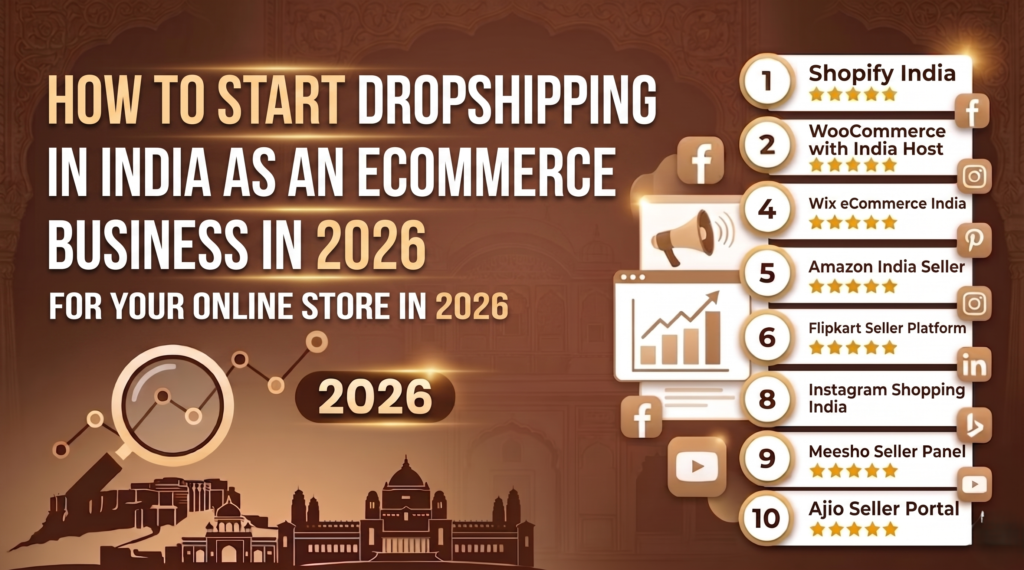
Dropshipping in India as an ecommerce business is becoming one of the fastest-growing online business models in 2026. Starting a dropshipping business in India allows entrepreneurs to sell products online without managing inventory, warehousing, or shipping operations. With the rise of ecommerce adoption, UPI payments, and domestic supplier networks, more people are launching a drop shipping business in India with low investment and scalable profit potential.
That model is straightforward on paper. In practice, starting a dropshipping business in India in 2026 involves navigating platform choices, GST compliance, payment gateway setup, supplier reliability, and return rate management — all of which are distinctly different from running a dropshipping business in the US or UK. Indian consumers rely heavily on Cash on Delivery. Return rates are high in fashion and electronics. Domestic suppliers vary wildly in quality and shipping speed.
The popularity of dropshipping in India as an ecommerce business continues to grow because it allows sellers to launch online stores without investing heavily in inventory or warehouse management. Many entrepreneurs now prefer starting a dropshipping business in India because ecommerce platforms, payment gateways, and supplier networks have become easier to access. With the rise of digital shopping and social commerce, a drop shipping business in India can now be started with relatively low investment compared to traditional retail businesses.
This guide is written specifically for the Indian market. It covers everything you need to go from zero to a functioning store: the legal requirements, the right platforms, how to find reliable suppliers, how to handle GST, and how to get your first paying customers. Whether you are a student looking for your first income stream or a professional considering a side business, the steps here are practical, current, and built for 2026.
Why Dropshipping in India as an Ecommerce Business Is Growing Fast
The growth of ecommerce has created massive opportunities for entrepreneurs interested in dropshipping in India as an ecommerce business. Thousands of new sellers are entering the market because a dropshipping business in India requires lower investment compared to traditional retail models. Modern ecommerce platforms, fast shipping networks, and reliable dropshipping suppliers India businesses now make it easier to start and scale an online store.
Many beginners prefer working with India dropshipping suppliers because they provide faster delivery, easier return handling, and better communication compared to overseas vendors. Popular dropshipping companies in India such as IndiaMart, GlowRoad, and Meesho suppliers are helping ecommerce businesses operate more efficiently in 2026.
What Is Dropshipping in India as an Ecommerce Business and How Does It Work?
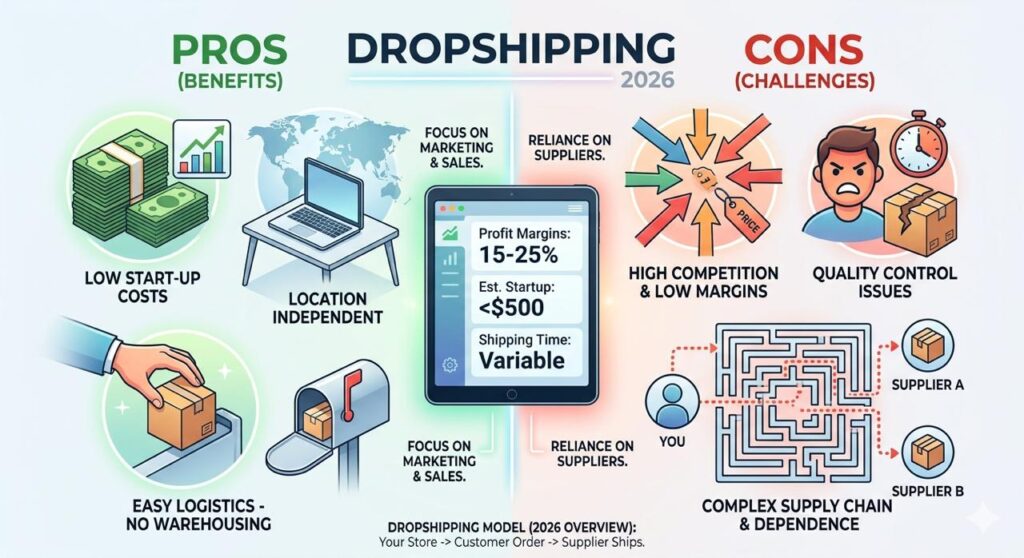
In India, this model works across both domestic and international supply chains used by many dropshipping companies in India.”
For beginners entering ecommerce, dropshipping in India as an ecommerce business provides flexibility and scalability without the operational burden of maintaining stock. Many ecommerce sellers work with trusted dropshipping suppliers India networks to manage inventory, fulfillment, and shipping. These India dropshipping suppliers help businesses reduce operational costs while improving delivery speed and customer satisfaction.
In India, this model works across both domestic and international supply chains. You can source products from Indian suppliers on platforms like IndiaMart or GlowRoad and sell to Indian customers, or you can source from AliExpress and sell to international buyers. Each approach has different implications for shipping time, return handling, payment processing, and GST compliance.
The most important distinction for Indian dropshippers is that you are the seller of record. Even if you never touch the product, you are legally responsible for the customer’s purchase experience, the invoice, and tax compliance. This is a commonly misunderstood point that creates compliance problems for new entrepreneurs.
Is Dropshipping Legal in India?
Yes, dropshipping is completely legal in India. There is no specific law that prohibits the dropshipping model. However, you must comply with Indian ecommerce regulations, GST rules, and consumer protection laws. You are required to register for GST once your annual turnover exceeds the threshold, issue proper invoices, and comply with the Consumer Protection (E-Commerce) Rules 2020.
Legal Area | Requirement | Applicable To |
GST Registration | Mandatory above ₹20 lakh turnover (₹10 lakh in special category states) | All Indian dropshippers |
Business Registration | Sole proprietorship, LLP, or Pvt Ltd (not mandatory to incorporate, but recommended) | All Indian dropshippers |
Consumer Protection Rules 2020 | Display seller info, return policy, grievance officer details on your website | All ecommerce sellers |
Import-Export Code (IEC) | Required only if shipping to or from international locations | Cross-border dropshippers |
FSSAI License | Mandatory if dropshipping food, health, or nutrition products | Food-related categories |
Many beginners assume that because they do not physically handle products, they operate in a legal grey area. That is incorrect. The Indian government’s Consumer Protection (E-Commerce) Rules 2020 hold online sellers fully accountable for product claims, delivery timelines, and return handling — regardless of whether they hold inventory. Operating without GST registration beyond the threshold is a compliance risk that can result in penalties.
Why Dropshipping Business in India Is a Strong Ecommerce Opportunity in 2026
India’s ecommerce market crossed $70 billion in gross merchandise value in 2024 and is projected to reach $110–120 billion by 2027. Smartphone penetration now exceeds 700 million users, and UPI has fundamentally changed digital payment adoption — India processes more UPI transactions monthly than any other country in the world.
Several factors make 2026 particularly favorable for new dropshipping businesses in India:
- Rising tier-2 and tier-3 city demand: Over 65% of new ecommerce buyers in India now come from smaller cities where organized retail is still limited. These buyers are underserved and actively purchasing online.
- Maturing logistics infrastructure: Third-party logistics providers like Shiprocket, Delhivery, Ecom Express, and XpressBees have expanded reach to more than 27,000 pin codes, making reliable delivery to non-metro areas more practical than ever.
- Social commerce growth: Instagram, Facebook, and Meesho have normalized discovery-to-purchase behavior on social platforms. Indian consumers are comfortable buying from unfamiliar brands they discover through social media.
- Competitive supplier ecosystem: The post-pandemic period saw significant growth in Indian manufacturers and wholesalers listing on IndiaMart and similar B2B platforms, giving domestic dropshippers more supplier options than existed three years ago.
- Lower barrier to global selling: International payment gateways with Indian bank account support and FEMA-compliant payout structures have made it more practical for Indian entrepreneurs to run globally-targeted dropshipping stores.
Step-by-Step Guide to Starting a Dropshipping Business in India
Step 1 — Choose Your Niche
Your niche is the single most important decision you will make. It determines your supplier options, your competition level, your average order value, and your return rate. In India, the following categories have proven strong for dropshipping: home and kitchen products, mobile accessories, fashion and apparel, health and fitness equipment, baby products, and pet supplies.
Choosing the right niche is extremely important for building a profitable dropshipping business in India. Ecommerce categories with consistent demand, manageable return rates, and strong supplier availability usually perform better over time. Many successful stores also research trending products across major dropshipping sites in India before selecting their niche and marketing strategy.
Avoid entering highly saturated niches like generic phone cases or mass-market fashion without a clear differentiation angle. Use tools like Google Trends India, Meesho’s trending section, and AliExpress hot products to identify rising demand before it peaks.
Step 2 — Register Your Business
You do not need to incorporate a company on day one, but you do need a legal structure to open a business bank account and apply for GST. A sole proprietorship is the simplest and cheapest starting point. You will need a PAN card, Aadhaar card, and a business bank account. Once registered, apply for a GST number through the GST portal — this is mandatory for running any ecommerce store in India, even before you hit the turnover threshold, because most payment gateways and ecommerce platforms require it.
Every ecommerce entrepreneur starting a drop shipping business in India should focus on proper GST registration, payment gateway setup, and legal documentation from the beginning. Many ecommerce platforms and dropshipping services in India require business verification before enabling full payment processing and COD functionality.
Step 3 — Select Your Platform
Some sellers also explore Amazon dropshipping India models by combining supplier fulfillment with Amazon marketplace listings. However, independent ecommerce stores on Shopify or WooCommerce generally provide better branding control, customer ownership, and long-term scalability compared to marketplace-only selling.
Shopify, WooCommerce, Meesho, and GlowRoad are among the most commonly used dropshipping sites in India for ecommerce businesses. These platforms support automation tools, supplier integrations, and mobile-friendly storefronts that help entrepreneurs scale a dropshipping business in India more effectivel
Choosing the right ecommerce platform is critical for long-term growth because your store design, loading speed, and mobile experience directly impact conversions. Businesses that want to build a professional online store should also explore our guide on 10 Best Ecommerce Website Builders for Your Online Store in 2026 to compare the best ecommerce solutions for scaling a successful dropshipping business in India. If you need a custom ecommerce setup, our website development services can help create a high-converting online store optimized for SEO, mobile performance, and customer experience.
Step 4 — Find and Verify Suppliers
When choosing suppliers, focus on verified dropshipping suppliers India businesses that can provide fast shipping, stable inventory, and reliable return handling.
Working with trusted dropshipping suppliers India businesses is essential for maintaining product quality and customer satisfaction. Many ecommerce sellers prefer domestic India dropshipping suppliers because local fulfillment reduces shipping delays and simplifies return handling. Reliable dropshipping companies in India can also improve delivery timelines and operational efficiency for growing online stores.
Step 5 — Build Your Store
Keep your store setup focused on conversion, not aesthetics. Use a clean theme, write clear product descriptions that address buyer concerns (sizing, material, shipping time), and set up trust signals: return policy, contact information, and customer reviews. On Shopify, install DSers or AutoDS to automate order forwarding to your supplier. Set up your custom domain — a .in domain for Indian audiences costs approximately ₹800–1,200 per year.
Step 6 — Set Up Payment Gateways and COD
For sellers planning to scale their drop shipping business in India, offering multiple payment methods is essential. UPI, debit cards, COD, and EMI options significantly improve conversion rates for Indian buyers. Many modern dropshipping services in India now integrate directly with Razorpay, PayU, and Cashfree, making payment automation easier for ecommerce businesses.
Step 7 — Drive Traffic to Your Store
Paid advertising is the fastest route to your first sale. Facebook and Instagram Ads are the dominant channels for Indian dropshipping, with CPMs (cost per thousand impressions) generally lower than Western markets. Google Shopping Ads work well for product-specific searches. For organic growth,
focus on Instagram Reels, YouTube Shorts, and Pinterest — all of which have strong shopping discovery intent among Indian buyers. Influencer partnerships with micro-influencers (10,000–100,000 followers) in your niche are cost-effective and often outperform paid ads for trust-sensitive categories.
Marketing plays a major role in the success of every dropshipping business in India because consistent traffic is necessary for generating sales and building brand awareness. Businesses looking to improve ecommerce visibility and customer acquisition should also read our guide on digital marketing trends in 2026 – what business need to know to understand how AI, social commerce, and performance marketing are changing online business growth. Brands that want faster growth can also use our Best digital marketing Agengy in Rajasthan to improve SEO, paid advertising, and social media performance for their ecommerce store
Many ecommerce brands running a dropshipping business in India use Instagram Reels, Facebook Ads, influencer collaborations, and YouTube Shorts to attract customers. Social commerce trends have significantly improved growth opportunities for sellers using dropshipping sites in India to launch niche-focused online stores.
Step 8 — Manage Orders, Returns, and Customer Service
Use a single dashboard — Shopify’s native order management or a tool like Easycom — to track all orders and communicate shipping updates to customers. Set clear expectations on delivery timelines on your product pages (domestic India orders: 5–9 days; international: 12–30 days). Create a simple, visible return policy. High return rates in fashion and electronics are a structural reality of Indian ecommerce — price this risk into your margins rather than hoping it does not apply to you.
Best Dropshipping Suppliers India for Ecommerce Businesses
Supplier | Type | Best For | Shipping Speed (India) | Key Advantage |
IndiaMart | Domestic B2B | All categories | 3–7 days | Largest Indian supplier database; direct manufacturer contact |
GlowRoad | Domestic | Fashion, home, lifestyle | 4–8 days | Pre-vetted suppliers; reseller-friendly catalog |
Meesho Supplier | Domestic | Fashion, accessories | 5–9 days | Zero-commission model; built-in buyer base |
AliExpress | International | All categories | 15–45 days | Massive product range; competitive wholesale pricing |
CJ Dropshipping | International | Electronics, accessories | 10–20 days | Faster shipping than AliExpress; custom packaging |
Spocket | International | US/EU targeted stores | 3–10 days (if US/EU seller) | Premium suppliers; shorter delivery for Western customers |
TradeIndia | Domestic B2B | Industrial, home goods | 4–9 days | Strong in niche B2B categories |
Choosing the right dropshipping suppliers India network is critical for long-term ecommerce success. Reliable India dropshipping suppliers help reduce delivery delays, product quality complaints, and return issues. Many successful ecommerce entrepreneurs now work with domestic dropshipping companies in India because local fulfillment improves customer trust and overall conversion rates.
GST and Legal Compliance for Indian Dropshippers
Reliable dropshipping suppliers India networks are important for maintaining fast delivery, lower return rates, and consistent product quality. Ecommerce businesses that partner with experienced India dropshipping suppliers usually perform better because domestic shipping is faster and customer support communication is easier. Many successful dropshipping companies in India now offer automation tools and reseller-friendly supplier systems.
Compliance Item | Details | When Required |
GST Registration | Apply via GST Portal (gst.gov.in); free of cost | Before first sale (practically) |
GSTIN Display | Your GST number must appear on all invoices | Mandatory from registration |
GSTR-1 Filing | Monthly or quarterly outward supply return | Ongoing; monthly if turnover > ₹5 cr |
GSTR-3B Filing | Summary return with tax payment | Monthly |
TCS Deduction | Marketplace platforms deduct 1% TCS at source | Automatic; claim as input credit |
Import Duty (if applicable) | Customs duty on goods imported for dropshipping from outside India | Cross-border shipments |
One practical nuance specific to Indian dropshipping: when you use a domestic supplier who ships directly to the buyer, two transactions are technically occurring — the supplier selling to you, and you selling to the buyer. Both transactions may attract GST. Working with a chartered accountant who understands ecommerce from the outset will save you far more than their fee in the long run.
Setting Up Payment Systems for a Dropshipping Business in India
Payment infrastructure is where many international dropshipping tutorials fail Indian merchants. Most advice assumes you are collecting payments in USD and receiving payouts to a US bank account. The Indian context is different.
- Razorpay: The most popular choice for Indian merchants. Supports UPI, all major debit and credit cards, net banking, wallets, and EMI. Charges 2% per transaction. Offers instant payouts and strong API documentation.
- PayU: Strong competitor to Razorpay with similar feature set. Often used by larger merchants for its advanced fraud detection. Charges 2%+ per transaction depending on plan.
- Cashfree Payments: Particularly strong for businesses that need fast settlement and COD reconciliation. Good documentation for Shopify integration.
- Stripe (for international stores): If you are targeting international customers, Stripe supports Indian bank account payouts under FEMA regulations. Requires a company registration and foreign exchange earnings compliance.
- UPI (via Razorpay/PayU): UPI integration is non-negotiable for Indian-targeted stores. It is free for buyers and has become the default payment method for a significant portion of Indian online shoppers.
Latest Trends in Indian Dropshipping for 2026
Social Commerce and Live Selling
Instagram Live shopping and the rapid growth of Meesho’s social reseller network have fundamentally changed how Indian consumers discover and buy products. Dropshippers who integrate live selling into their marketing — showcasing products in real time via Instagram or YouTube — are seeing conversion rates significantly higher than static ad campaigns.
Domestic Supplier Preference
Cross-border ecommerce is also growing rapidly, with many entrepreneurs now dropshipping from India to USA and other international markets. Indian manufacturers and suppliers are increasingly offering global shipping support, creating new opportunities for sellers who want to target overseas buyers through Shopify and WooCommerce stores.
AI-Powered Product Research
Tools like Minea, AutoDS, and Dropship.io now include AI-powered trend analysis that identifies winning products before they saturate. Indian dropshippers are increasingly using these tools alongside manually monitoring Meesho’s trending section and Flipkart’s bestseller lists to identify local demand signals.
Print-on-Demand as a Dropshipping Vertical
Print-on-demand services — custom t-shirts, phone cases, home décor with original designs — are growing as a dropshipping vertical in India. Platforms like Printify and Indian providers like Printrove make it possible to offer differentiated products without design skills, and the margin profile is often better than generic product reselling.
Key Challenges and How to Handle Them
High Return Rates
Return rates in Indian fashion ecommerce regularly exceed 25–35%. For a dropshipper who does not hold inventory, managing returns means coordinating between the buyer and the supplier — a process that can take weeks and erode margins entirely. The practical solution is to build a generous return policy that redirects returns to your own address rather than the supplier’s, inspect returned items yourself, and either resell or negotiate supplier credits for defective goods. Price your margins to absorb a realistic return rate from the outset.
COD Order Cancellations and NDR (Non-Delivery Reports)
COD orders in India carry a meaningful risk of non-delivery — customers who ordered impulsively may not be available or willing to pay on delivery. NDR (Non-Delivery Report) rates of 15–25% are common in fashion and impulse-purchase categories. Shiprocket and other logistics providers offer NDR management dashboards. Calling customers to confirm COD orders before dispatch (a practice known as order confirmation calls) reduces NDR significantly.
Supplier Reliability
The biggest operational risk in dropshipping everywhere — including India — is supplier inconsistency. A supplier who ships correctly 95% of the time will generate one customer complaint per 20 orders, which at scale means a constant stream of support tickets and refund requests. Always maintain at least two verified suppliers for your top-selling products, and never list a product until you have tested the supplier with a personal sample order.
GST and Accounting Complexity
Indian dropshippers who start without accounting infrastructure quickly find themselves with mismatched invoices, unclaimed TCS credits, and misreported returns. From month one, use accounting software like Zoho Books, ClearTax, or Tally to track every transaction. The cost of a CA who handles your quarterly GST filings is modest; the cost of a compliance notice is not.
Best Practices for Building a Profitable Indian Dropshipping Store
- Start with domestic suppliers: Domestic supply chains mean shorter delivery windows, easier return logistics, and no customs complications. Begin with Indian suppliers and expand internationally only once your operations are stable.
- Enable COD from day one: More than 60% of your potential Indian customer base will not pay online upfront. Not offering COD is voluntarily excluding a majority of the market.
- Keep your initial product range small: Start with 10–20 products maximum. Deep knowledge of a few products is worth more than a broad catalog you cannot manage or market effectively.
- Automate order processing: Set up DSers, AutoDS, or a similar tool to forward orders to suppliers automatically. Manual order processing at any meaningful volume leads to errors and delays.
- Build a trust-first store design: Indian online buyers are increasingly savvy. Clear return policies, visible contact information, genuine product photos (not supplier stock images), and customer reviews significantly improve conversion rates.
- Track your unit economics from the first sale: Know your exact cost per order: product cost + shipping + payment gateway fee + ad spend. If your margin after all costs is below ₹150–200 per order, the business model needs adjustment before you scale.
Common Mistakes to Avoid
- Skipping GST registration and operating without tax compliance — penalties and platform account suspension are the typical result.
- Listing products without testing them from the supplier — quality issues discovered by customers destroy your store’s reputation before it gains momentum.
- Ignoring return rate in your margin calculations — a 20% return rate on a ₹100 margin product effectively erases profit on every fifth order.
- Running ads to a store that has not been conversion-optimized — spending on traffic to a slow-loading, poorly designed store is burning money.
- Using AliExpress for India-targeted stores — 15–45 day delivery times are not acceptable to most Indian buyers. Use domestic suppliers for India-focused dropshipping.
- Copying product descriptions verbatim from suppliers — duplicate content hurts SEO, and supplier descriptions are rarely written for Indian buyers.
- Choosing a niche based on interest rather than research — passion for a product category is helpful but insufficient. Validate demand with data before building a store.
Future Outlook: Where Indian Dropshipping Is Heading
The next three years in Indian ecommerce will be shaped by several structural shifts that directly affect dropshippers.
The ONDC (Open Network for Digital Commerce) — India’s government-backed open protocol for ecommerce — is gradually reducing the dominance of Amazon and Flipkart and creating new discovery channels for independent sellers. Dropshippers who list on ONDC-compatible platforms early will benefit from lower customer acquisition costs compared to marketplace advertising.
Quick commerce is setting new delivery expectations in urban India. While 10-minute delivery is not realistic for most dropshipping models, customers in metro areas now expect delivery within 2–3 days. This will accelerate the shift toward local and regional fulfillment networks, and may create opportunities for hybrid models where dropshippers maintain a small buffer stock in fulfillment hubs.
AI-assisted store management will become standard. From automated product description generation to AI-powered ad optimization and dynamic pricing, the operational overhead of running a dropshipping store will decrease as accessible AI tools mature. Merchants who adopt these tools early will achieve the same output with significantly less manual effort.
Finally, the regulatory environment is tightening. The Indian government has been moving steadily toward more formal ecommerce regulation — greater transparency requirements, stricter data protection under the Digital Personal Data Protection Act, and more robust consumer protection enforcement. Running a compliant business from the beginning will be a competitive advantage as enforcement catches up with the informal players.
About the Author
I am Roshani Tanwani, Director of Markupgrowth, a results-driven digital marketing and ecommerce growth company focused on helping businesses scale online. With expertise in SEO, ecommerce website development, social media marketing, and AI-driven content strategies, I help brands improve online visibility and organic growth. My goal is to create high-quality, user-focused digital experiences that align with Google Helpful Content and E-E-A-T guidelines. Through data-driven marketing strategies and conversion-focused solutions, I help startups and businesses build strong online brands in competitive industries.

Conclusion
Dropshipping in India as an ecommerce business in 2026 is a legitimate and scalable online business model, but success depends on supplier quality, payment setup, and operational execution. Entrepreneurs building a successful dropshipping business in India are focusing on reliable suppliers, ecommerce automation, and customer experience rather than chasing unrealistic income claims.
The Indian market’s scale, its rapidly growing tier-2 and tier-3 buyer base, its mature logistics infrastructure, and its UPI-driven payment ecosystem all create genuine conditions for a well-run dropshipping business to succeed. The barriers are not technical — they are operational and strategic. Follow the steps in this guide, start small, validate before scaling, and treat each order as a data point that improves your business model.